Football clubs are always looking for fundraising ideas that are simple to organise, enjoyable to take part in and capable of bringing a whole community together. A Last Person Standing fundraiser can do all three.
The idea is easy to understand: players choose one football team to win each round. If their chosen team wins, they survive and make another pick in the next round. If their team draws or loses, they are eliminated. The competition continues until just one player remains.
That simple format can turn an ordinary run of league fixtures into weeks of conversation, friendly rivalry and engagement. For grassroots teams, youth clubs, supporters’ groups and community organisations, it can also provide a practical way to raise money for new equipment, travel, facilities or another agreed cause.
This guide explains how Last Person Standing works, what organisers need to decide before starting, and how a football club can use the game as part of its fundraising activity.
What is Last Person Standing?
Last Person Standing is a football prediction competition based on picking match winners rather than predicting exact scores.
At the beginning of each round, every active player selects one team from the available fixtures. If that team wins, the player stays in the competition. A draw or defeat usually means elimination. Players who survive then make a fresh selection in the following round.
The important twist is that a player will normally be prevented from selecting the same team twice during the competition. Someone might choose a strong favourite in the opening round, but that team will no longer be available to them later. Players therefore have to balance the chance of surviving today with the value of saving the strongest teams for future rounds.
This rule adds strategy without making the game difficult to understand. A lifelong football expert and a complete beginner can both join in, but neither is guaranteed to survive. An unexpected equaliser, a red card or a surprise away win can transform the standings in minutes.
A simple example
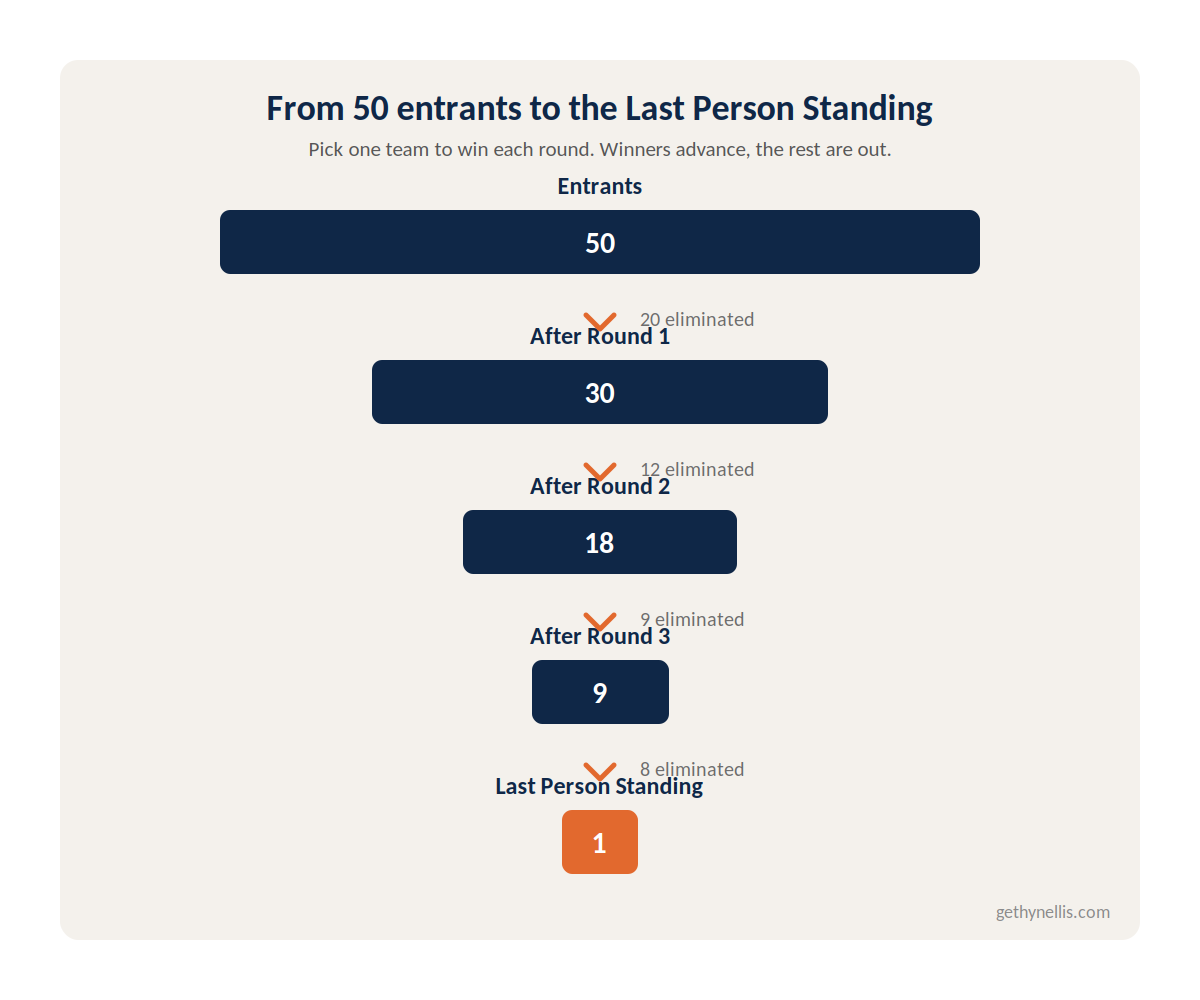
Imagine that 50 people enter a club’s competition.
In the first round, each person picks one Premier League team to win. Thirty players choose teams that win and advance. The other 20 are eliminated because their selections draw or lose.
The remaining 30 make another selection in round two, but they cannot reuse the team they picked previously. Perhaps 18 survive that round, then nine survive the next one. The field continues to narrow until only one eligible player remains.
The final player is the Last Person Standing and wins the prize set out in the competition rules. If every remaining player is eliminated in the same round, the organiser applies the tie or rollover rule published before the competition began. For example, all of those players might be reinstated for another round, or an agreed tie-break process might be used.
The exact rules can vary, which is why every organiser should publish them clearly before accepting entries.
How players take part on the platform
An organiser creates a competition, chooses its settings and shares an invitation link or code. Players use that invitation to join the correct private competition.
Before each deadline, an active player opens the available fixtures and submits a team selection. The platform records the pick, applies the competition’s deadline and tracks whether the team wins, draws or loses. It also keeps the standings up to date as the competition progresses.
This removes much of the repetitive administration normally associated with running the game through spreadsheets, group chats and handwritten lists. The organiser can see who has joined, monitor selections and manage the competition, while players can check their own progress in one place.
The platform is competition-management software. The club remains the organiser of its fundraiser and manages entry contributions and prizes directly. Entry payments, prize money and fundraising proceeds are not collected, held or distributed by the platform.
Why the format works well for football clubs
It is easy to explain
Fundraising activities work best when people can understand them immediately. “Pick one team to win and stay in if they win” is a much smaller barrier to entry than a complicated fantasy league or detailed score-prediction contest.
Players do not need to build a squad, understand transfer budgets or calculate points. They only need to make one decision before each deadline.
It creates repeat engagement
A raffle may produce income, but there is often little interaction between buying a ticket and announcing the winner. Last Person Standing can create a reason for players to return every round.
People discuss their picks, follow matches they might otherwise ignore and compare their progress with teammates, parents, coaches and supporters. The club can share reminders, celebrate narrow escapes and post updates as the field gets smaller.
It can involve the wider community
The competition does not have to be limited to registered players. Subject to the club’s rules and any applicable legal or safeguarding requirements, parents, volunteers, former players, sponsors and supporters may also be invited.
That wider reach can make the fundraiser more valuable while strengthening the connection between the club and its community.
It can be repeated
A competition may last for several weeks, depending on results. Once it ends, the club can decide whether to start another later in the season. It is better to run a well-organised competition with clear communication than to ask supporters for contributions too frequently, but the format is reusable.
How a club can generate fundraising income
A common approach is to ask each participant for a fixed contribution to enter. The amount collected is then divided between the club’s fundraising purpose and the winner’s prize.
For example, suppose 100 people each contribute £10. The total collected would be £1,000. If the published split assigns 50% to the fundraiser and 50% to the prize, the club would allocate £500 to its cause and £500 to the winner’s pot.
The club should decide and communicate the split before entries open. Participants should be able to see:
- the entry contribution;
- the percentage or amount allocated to fundraising;
- the percentage or amount allocated to prizes;
- what happens if there is more than one remaining player;
- what happens if all remaining players are eliminated together;
- whether any refunds are available; and
- who is responsible for collecting contributions and paying the prize.
Transparency matters. Supporters are more likely to take part when they know why the club is raising money and how the proceeds will be used. A specific goal, such as new training equipment, tournament travel, pitch improvements or subsidised membership, can be more compelling than a general request for funds.
Check the rules that apply before you start
Any competition that combines an entry fee with a prize needs to be run within the rules that apply to fundraising and prize competitions in your country. In Great Britain, for example, the Gambling Commission publishes guidance on how clubs and societies can run lotteries and competitions lawfully, and many small club fundraisers operate under specific exemptions.
This article is not legal advice. Before opening entries, check the current guidance that applies to your club, confirm whether your format needs any registration or permission, and keep your published rules consistent with how the money is actually handled. Ten minutes of checking up front is far cheaper than a dispute later.
A step-by-step plan for organisers
1. Choose a fundraising purpose
Start with a clear, credible goal. Explain what the club needs, how much it hopes to raise and who will benefit. This gives the competition a story that people can share.
2. Agree the rules
Decide which league and fixtures will be used, when picks close, whether teams can be selected more than once, and how postponements or abandoned matches will be handled.
Also decide how the winner is determined if unusual results leave no player standing. Do not wait for a disputed situation before inventing a rule.
3. Set the entry contribution and the split
Choose an entry amount that suits your community. A lower contribution with more entrants often raises more than a high entry fee that puts people off. Publish the fundraising and prize split, the payment method the club will use to collect contributions, and who at the club is responsible for the money.
4. Set up the competition
Create the competition on the platform, apply your chosen settings and check the first deadline against the fixture list. Run a quick test with a couple of committee members before inviting everyone else, so the first round is not also your first rehearsal.
5. Invite players and promote it
Share the invitation link through the channels your community already uses: team group chats, the club’s social media pages, newsletters and noticeboards. Lead with the cause, not the mechanics. “Help us fund new goals for the under-8s, and you might win £500” is a better message than a paragraph of rules.
6. Run the rounds and keep talking
Send a reminder before each deadline, then post an update after each round: how many survived, who went out on a last-minute equaliser, and what the surviving numbers look like. The stories between rounds are what keep the competition alive and make the next one easier to fill.
7. Announce the winner and report back
Celebrate the winner publicly, pay the prize promptly, and then close the loop on the fundraising: tell supporters how much was raised and what it will be spent on. When people see the new kit or the resurfaced pitch, they will be first in the queue for the next competition.
The takeaway
Last Person Standing works as a fundraiser because it turns something your community already cares about, the weekend’s football, into weeks of shared involvement with a clear cause attached. The clubs that do it well decide their rules and their split up front, communicate constantly, and let the platform handle the administration so volunteers can focus on the fun part.
Run your club’s competition on Last Person Standing
The platform handles invitations, pick deadlines, results and standings, so your volunteers do not have to wrestle with spreadsheets. Set up a private competition for your club and have your first round live in minutes.
Set up your club’s competition
PakarPBN
A Private Blog Network (PBN) is a collection of websites that are controlled by a single individual or organization and used primarily to build backlinks to a “money site” in order to influence its ranking in search engines such as Google. The core idea behind a PBN is based on the importance of backlinks in Google’s ranking algorithm. Since Google views backlinks as signals of authority and trust, some website owners attempt to artificially create these signals through a controlled network of sites.
In a typical PBN setup, the owner acquires expired or aged domains that already have existing authority, backlinks, and history. These domains are rebuilt with new content and hosted separately, often using different IP addresses, hosting providers, themes, and ownership details to make them appear unrelated. Within the content published on these sites, links are strategically placed that point to the main website the owner wants to rank higher. By doing this, the owner attempts to pass link equity (also known as “link juice”) from the PBN sites to the target website.
The purpose of a PBN is to give the impression that the target website is naturally earning links from multiple independent sources. If done effectively, this can temporarily improve keyword rankings, increase organic visibility, and drive more traffic from search results.